MakeUGC and its alternatives at a glance
 SmartUGC
- Public pricing pageMakeUGC YesSmartUGC YesArcads No (in-app only)Creatify Yes
- Pricing unitMakeUGC Usage creditsSmartUGC Finished videosArcads Credits + seconds/video capsCreatify Step credits
- Named video modelsMakeUGC Seedance 2.0SmartUGC Seedance 2.0 + Veo 3, every planArcads Unnamed ("all models")Creatify Multi-model pipeline
- Product in handMakeUGC $149 planSmartUGC From $69 planArcads Via custom promptsCreatify Mode-dependent
- Custom avatarMakeUGC IncludedSmartUGC From $69 planArcads Custom planCreatify $99 plan (3 avatars)
- Credits roll over on upgradeMakeUGC Not statedSmartUGC YesArcads Not statedCreatify Not stated
- Automatic refund on failed generationsMakeUGC Not statedSmartUGC YesArcads Not statedCreatify Not stated
- Royalty-free, no usage limitsMakeUGC Not statedSmartUGC YesArcads Not statedCreatify Not stated
We build SmartUGC, one of the alternatives below. MakeUGC, Creatify, and SmartUGC prices come from public pricing pages checked July 3, 2026; Arcads publishes no pricing page, so its figures come from its in-app pricing screen (July 2026, GBP; dollars at roughly $1.33 per £1, rounded) and may change. Corrections welcome at [email protected].
Why people go looking for MakeUGC alternatives
MakeUGC's output is fine. Its avatars are competitive and it moves fast on new models. The complaints that push people to this page are about the buying experience, not the videos.
The credit system is the big one. MakeUGC's plans quote credits (500, 1,000, 2,000) that meter model usage per generation, and the pricing page never states how many credits a typical video costs. Subscribers find out their effective per-video price after paying, and it moves with the model, length, and settings they choose. Budgeting becomes guesswork.
The promotional framing is the second. Every tier displays a struck-through price with a permanent-looking "50% OFF" label, next to a rotating "24h offer" and bonuses that "only activate after your $1 trial ends and your first full billing cycle begins". Each element is defensible alone; together they make the page feel like it is negotiating with you.
The third is the gate on the best feature. Product-in-hand videos, the format this category is famous for, need the $149 Pro plan. Founders who came specifically for that format bounce on the price. On SmartUGC the same format is included from the $69 Creator plan.
What to check before you switch

Whatever you pick next, four checks prevent a second disappointment.
First, the unit. Tools sell either finished videos or metered credits. Finished-video pricing is legible up front; metered pricing rewards high-volume users who verify the burn rate during a trial. On SmartUGC each plan is a fixed number of finished videos, so the number on the pricing page is the number of ads you get.
Second, where product-in-hand and custom avatars sit. On SmartUGC both are included from the $69 Creator plan, against MakeUGC's $149 for product-in-hand and Creatify's $99 for avatars.
Third, the renewal price. Ignore banners and countdowns; find the number your card gets charged in month two and compare tools on that. SmartUGC's renewal price is the same public number you saw on the pricing page.
Fourth, the regeneration policy. All of these tools charge for edits, because an edit is a new generation. SmartUGC refunds a failed generation automatically, so a bad render never costs you a video; check the equivalent policy anywhere you go.
SmartUGC: the same workflow, sold in videos
Disclosure first: SmartUGC is our product.
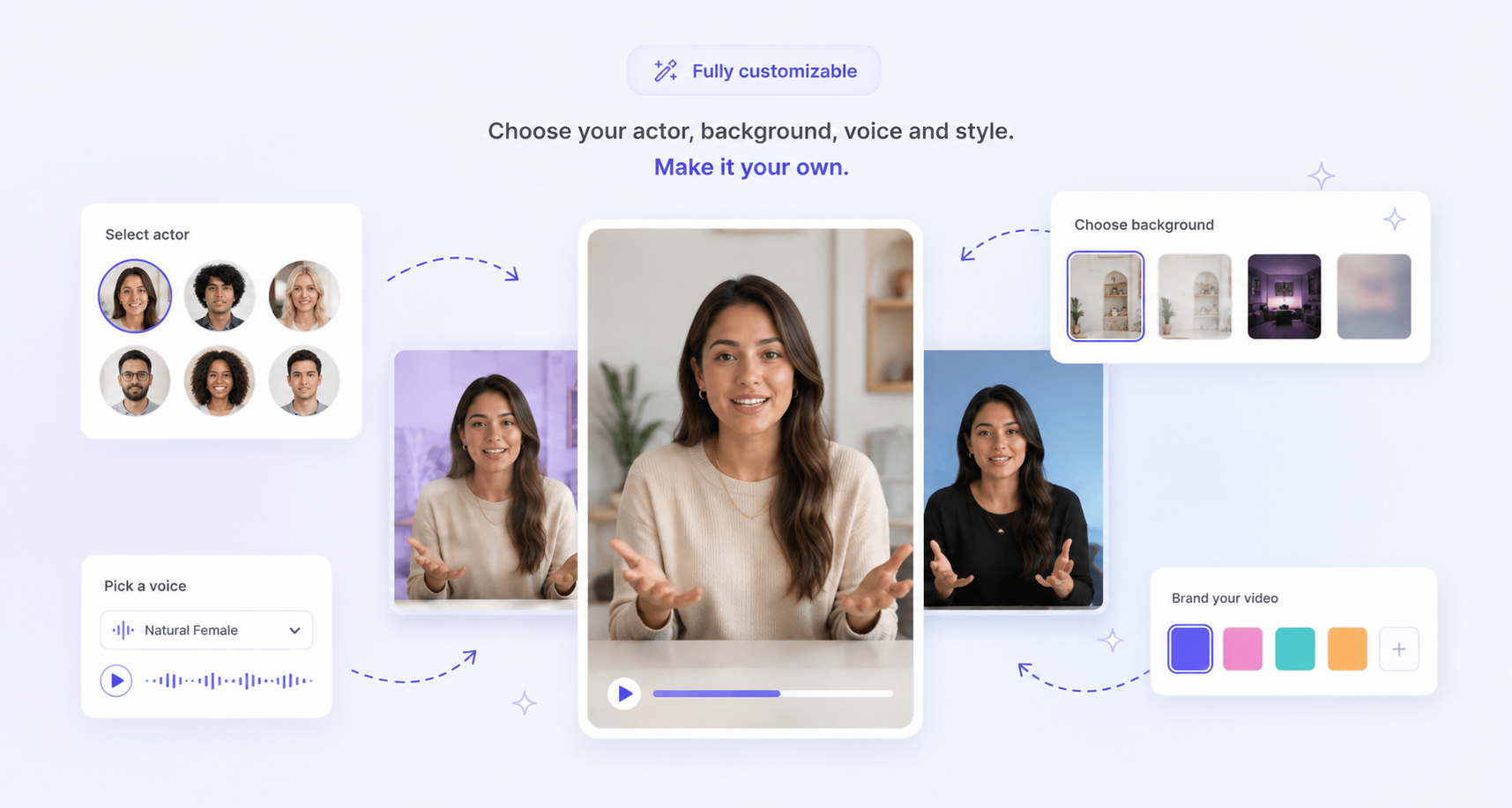
The workflow is the one you already know from MakeUGC (write or generate a script, pick a photoreal AI actor or your custom avatar, generate), and every ad it produces is watermark-free from day one. The difference is the unit of account. SmartUGC plans buy finished videos: 5 for $49, 10 for $69, 20 for $119, 50 for $249. No burn-rate discovery, no strike-through pricing, and the number on the pricing page is the number on your invoice.
The feature gates sit lower, too. Product-in-hand and custom avatars are included from the $69 Creator plan, against MakeUGC's $149 Pro. Every plan, including the $49 one, ships the full actor catalogue, the B-roll generator, image generation, AI image ads, bulk creation, and both Seedance 2.0 and Veo 3 named up front. Unused videos roll over when you upgrade, output is royalty-free with no usage limits, and you can cancel anytime.
MakeUGC offers its own automation in the Video Agent and AI Workflows, and a self-serve API from $99 a month. If your operation leans on those, the head-to-head comparison walks through both tools in detail. If it leans on knowing exactly what you will pay for what you will get, that is the trade we built for.
Arcads: the premium option
Some MakeUGC subscribers are not price-sensitive; they are quality-and-brand sensitive, and their frustration is the discount-banner aesthetic rather than the invoice. Arcads sits at the opposite pole. It runs no promo banners and publishes no pricing at all: as of July 2026 its in-app plans run about $115 and $225 a month (£85 and £170 in-app) plus a custom tier, and its customer list is heavy with funded D2C brands and agencies.
At the time of writing, the in-app plans include a tiered actor library, avatar reactions, and, on the custom plan, actor cloning, team collaboration, and API access. There is no cheap way to test it (no trial was listed), and plans meter credits, avatar-talking seconds, and video counts together, so a single monthly cost is hard to read in advance.
Moving from MakeUGC to Arcads makes sense mainly for agencies whose clients expect the recognised name and whose margins absorb the entry price without noticing. For a founder or small brand who wants a public price and watermark-free ads they can publish, SmartUGC is the closer fit. The Arcads alternatives page runs this logic in the other direction.
Creatify: the platform option
Creatify is a full ad platform rather than a focused UGC tool. It meters credits on each generation step, so a polished ad that goes through several steps and variations consumes credits in ways that take a month or two to develop intuition for, the same legibility question MakeUGC raises in different clothes. UGC is one mode inside it, so the talking-actor format gets less dedicated focus than it does on a specialist, and custom avatars start at its $99 tier against $69 on SmartUGC.
Pick Creatify over MakeUGC if a bundled ad platform matches how your team already works. Pick a specialist like SmartUGC if you just want good UGC ads at a price you can read up front, with product-in-hand and custom avatars from $69, named models on every plan, and watermark-free output you can publish. The SmartUGC vs Creatify page draws that line in detail.
Matching the alternative to your reason for leaving
If you are leaving because the credit math obscured your real costs: SmartUGC. It is the only tool on this page whose entry plan states the number of finished videos you get ($49 for 5), and the feature you probably wanted (product-in-hand) costs $69 instead of $149.
If you are leaving because you want a bundled ad platform rather than a focused generator: Creatify, with eyes open about its own credit metering.
If you are leaving because you want the premium brand and your budget genuinely does not care: Arcads.
If you are only halfway out the door: run MakeUGC's own numbers first. Generate a typical week of content during a billing cycle, divide the credits consumed into the renewal price, and get your true per-video cost. The point is that you should not need forensic accounting to know whether it is a good deal, and with SmartUGC you do not: five videos for $49 is five videos for $49.
- The lowest full-plan entry price
- Watermark-free ads you can publish
- A cost that is fixed per finished video
- Product-in-hand on a lower plan
- Be your own on-camera talent, cheaply
- The simplest write, pick, generate workflow
- Know exactly what renders your ad
- Scale up without losing what you paid
- Keep running ads after you cancel
Legibility is a feature
MakeUGC ships good videos behind pricing that takes effort to decode. SmartUGC fixes that directly: finished videos at public prices, the key formats from $69, named models on every plan, unused videos that roll over, and royalty-free output with no usage limits. Our biased but sincere suggestion: get started with SmartUGC, run your usual script, and see whether "5 videos for $49" feels different from "500 credits, 50% off, offer ends tonight".
Questions, answered.
What is the best MakeUGC alternative?
For transparent per-video pricing, product-in-hand and custom avatars at $69, named models on every plan, and watermark-free output you can publish, SmartUGC is the closest fit for founders and small brands. Creatify is the broad-platform option if you want a bundled ad tool, and Arcads is the premium, in-app-priced option for funded ad teams.
How many videos do MakeUGC credits actually make?
MakeUGC does not publish a credits-per-video rate; consumption depends on the model, length, and settings of each generation. The practical way to find your rate is to track credit burn during a normal week of use, then divide into the renewal price. SmartUGC avoids the question entirely: plans are denominated in finished videos, so five videos cost $49 and there is nothing to work out afterward.
How does MakeUGC’s $1 trial compare with starting on SmartUGC?
MakeUGC’s trial is pay $1, generate real videos, cancel if unconvinced, then it renews into credit tiers displayed with promotional discounts, and some advertised bonuses activate only after the first full billing cycle. SmartUGC does not run a trial: its plans start at $49 for 5 finished videos, every one watermark-free and ready to publish, and the price you see is the price you pay.
Which alternative includes product-in-hand cheapest?
SmartUGC, at the $69 Creator plan, which also includes a custom avatar. MakeUGC gates product-in-hand at $149. Creatify’s equivalent depends on generation mode and credits, and its custom avatars start at the $99 plan. Arcads handles it through custom avatar prompts, with cloned actors on its custom-priced tier.
Do these tools all use the same AI models?
SmartUGC is the one that names its models openly: Seedance 2.0 and Veo 3, on every plan including the $49 tier. MakeUGC, Creatify, and Arcads describe access to their models without naming a specific engine per plan, so you know less about what is generating your ads before you pay.
Which MakeUGC alternative is cheapest to run per video?
SmartUGC publishes a fixed per-video cost because plans are denominated in finished videos: from $5 per video on the plans here. MakeUGC, Creatify, and Arcads all meter credits or seconds, so their true per-video cost only emerges after a billing cycle of use.
Do unused videos roll over if I upgrade my plan?
On SmartUGC, yes: unused videos carry over when you move to a higher plan, so upgrading mid-cycle does not waste what you already paid for. The other tools here do not publish a roll-over policy, so confirm it in-app before you rely on it.
Is the output royalty-free and free of usage limits?
SmartUGC output is royalty-free with no usage limits, so you can run the same ad across as many placements and campaigns as you like. Check the licensing terms on any other tool before you scale a winning ad, since credit-metered platforms sometimes tie usage to plan tiers.
What happens if a generation fails?
SmartUGC refunds a failed generation automatically, so a failed render does not cost you a video. On credit-metered tools an edit or retry is a fresh generation, so confirm the failure and regeneration policy before you commit.
Can I cancel a MakeUGC alternative anytime?
SmartUGC is cancel-anytime with no lock-in, and every ad it makes is watermark-free and ready to publish. That is the simplest way to compare a plan denominated in finished videos against MakeUGC’s discounted credit tiers before you commit for the long run.
Related guides
Create scroll-stopping videos
in seconds.
Start now and cancel anytime.